| Typ <itemType> |
Objekt/föremål |
| Plats <presPlaceLabel> |
Afrika, Zambia, Bangweulusjön |
| Beskrivning <itemDescription> |
-
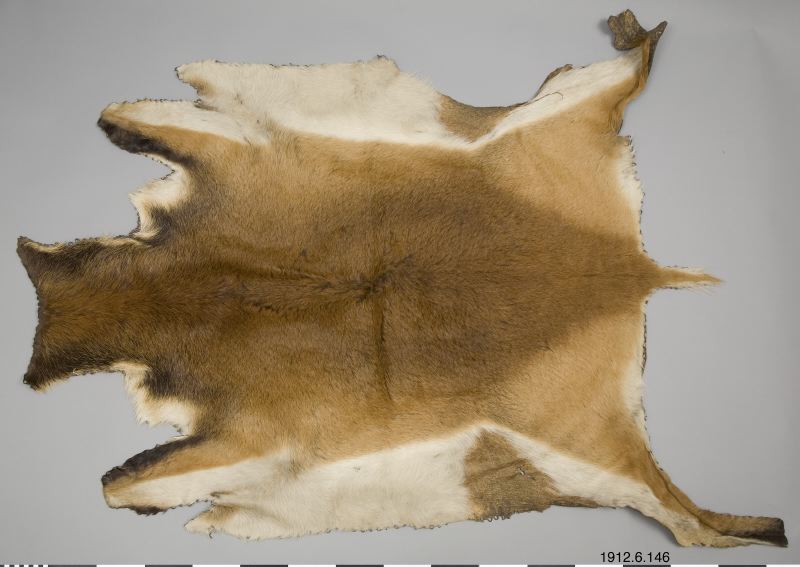
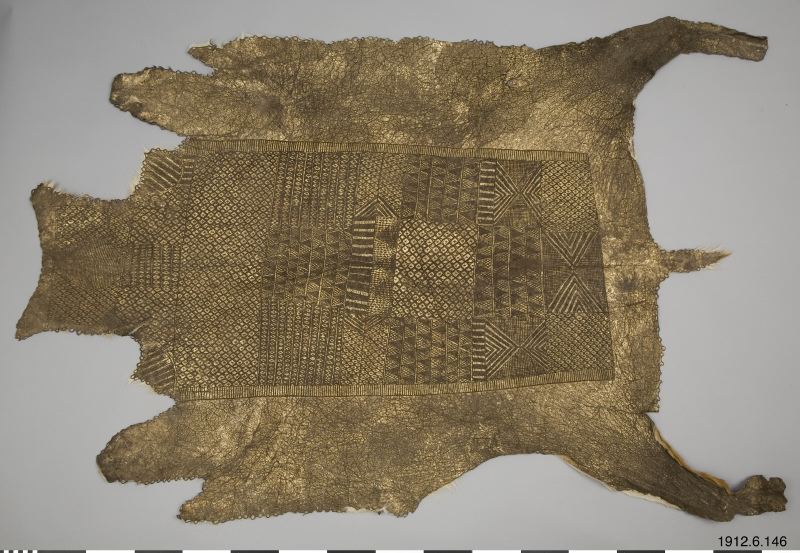
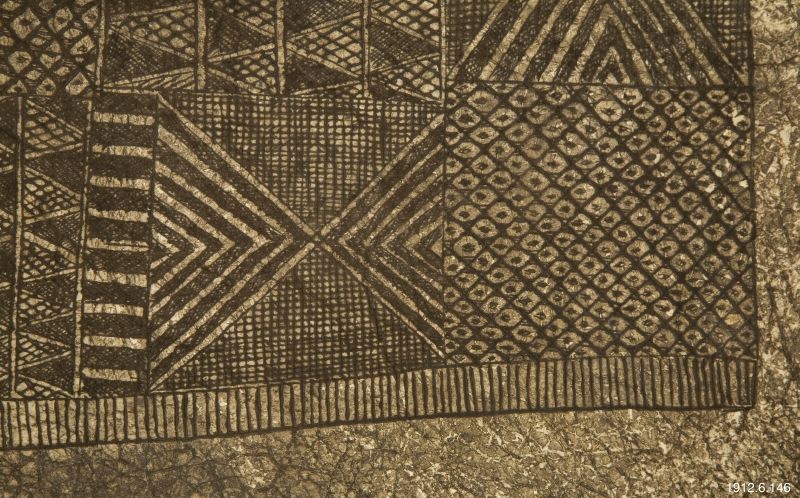
Enligt generalkatalogen: Kvinnomantel av antilopskinn (Cobus robertsi, Robert's letjevattenbock, nu utdöd). Inskurna romber. Timglas med vinklar och strecktecknade ytor. I mitten på halsfliken en stor, tvådelad, oval figur, möjligen representerande det kvinnliga könsorganet. [[Etno]]
|
| Publicerad text, engelska <itemDescription> |
-
"The ornamentation of the Batwa people is probably limited to purely geometric figures, without symbolic significance. On all the objects I examined, I have observed only a single ornament, which I ha...
Visa hela
"The ornamentation of the Batwa people is probably limited to purely geometric figures, without symbolic significance. On all the objects I examined, I have observed only a single ornament, which I have reason to suspect as an exception to this rule. This ornament appears on a pair of women's coats, and consists of an oval, which in its longitudinal direction is cut by two parallel, closely adjacent lines. In view of the great love of the natural peoples for erotic images, it is not impossible that this figure is a symbol of the female genitalia. At the bottom of the mantle pl. 41: Fig. A distinguishes a two-part oval, and on the mantle Fig. B on the same poster, the entire lower field is decorated with such. These ovals are often covered with fine lines or small dots (Figs. 37 and 38). See also pl. 5: Fig. B, where the woman on the left has had a two-part rhombus painted on her left shoulder. That this sign here has an erotic meaning, is very probable, since the woman at the time the picture was taken served as a kind of love priestess." (p. 155, von Rosen, 1916, translated from Swedish).
Stäng
|
| Publicerad text, engelska <itemDescription> |
-
"Batwa ornamentation is generally rectilinear. The skin flaps, which are found on the mantles between the front legs and the neck, are, however, not infrequently limited and sometimes also decorated w...
Visa hela
"Batwa ornamentation is generally rectilinear. The skin flaps, which are found on the mantles between the front legs and the neck, are, however, not infrequently limited and sometimes also decorated with hook lines (pl. 41: fig. A and pl. 43: fig. B). The two-part oval mentioned above is most common among the curvilinear ornaments. Four of these are often put together cross-shaped, so that they form flower-like figures (pl. 42: fig. A), which are sometimes inscribed in circles or squares (pl. 42: fig. B). They are also arranged in simple rows (pl. 41: fig. B) or in square or rectangular fields (pl. 43: fig. A). Surfaces adorned with rows of very small ovals arranged in rows also occur. Each oval is then provided in the middle with a smaller square or dot; see pl. 42: Fig. B, where the field to the right of the cross flower circumscribed is decorated in this way." (p. 155, von Rosen, 1916, translated from Swedish).
Stäng
|
| Publicerad text, engelska <itemDescription> |
-
"With the exception of the curvilinear figures listed above, all the ornaments on batwa mantles examined by me have been rectilinear. Among these figures, squares and rhombuses are the most common. Th...
Visa hela
"With the exception of the curvilinear figures listed above, all the ornaments on batwa mantles examined by me have been rectilinear. Among these figures, squares and rhombuses are the most common. These are arranged corner to corner or side to side in simple rows or in fields and are almost always provided with a smaller box in the middle. Sometimes every other row is made dark by scratching, every other light by carving. If a box is light, the smaller figure in the middle is made dark and vice versa. On pl. 43: fig. B we see the boxes arranged both in field and in lines. On the same mantle there is also a horizontal band, which is checkered, and another, extending between the front legs of the skin and adorned with a network of lines. On pl. 45: Fig. B we see a few more ways in which the grid pattern can be varied. Triangles and angles are also popular as ornaments and are assembled in a lot of different combinations, whereby a large variety of patterns arises. All mantles pictured here are provided with ornaments of this kind. On pl. 41: Fig. A, 45: Fig. B and 46: Fig. A are the triangular and angular ornaments particularly prominent. The woman standing on the left on pl. 40 wears a mantle with peculiar meander-like ornaments, which arose from the compilation of angles. When two triangles are placed one in the middle of the other with the tips facing each other, an hourglass-like figure appears, which we see on several of the mantles (pl. 42: fig. A, 44: fig. B and 46: fig. B )" (p. 156, von Rosen, 1916, translated from Swedish).
Stäng
|
| Beskrivning / engelska <itemDescription> |
-
According to the general catalog: Women's coat of antelope skin (Cobus robertsi, Robert's letjevattenbock, now extinct). Cut diamonds. Hourglass with angles and line-drawn surfaces. In the middle of t...
Visa hela
According to the general catalog: Women's coat of antelope skin (Cobus robertsi, Robert's letjevattenbock, now extinct). Cut diamonds. Hourglass with angles and line-drawn surfaces. In the middle of the neck flap a large, two-part, oval figure, possibly representing the female genitalia. [Ethno]
Stäng
|
| Utställning / tidigare <itemDescription> |
|
| Utställning / planerad <itemDescription> |
|
| Referens, publicerad i <itemDescription> |
|
| Geografiskt namn / annat <itemDescription> |
|
| Geografiskt namn / annat <itemDescription> |
|
| Land / engelska <itemDescription> |
|
| Geografiskt namn / annat <itemDescription> |
|
| Händelse / var närvarande vid <itemDescription> |
|
| Händelse / var närvarande vid <itemDescription> |
|
| Händelse / var närvarande vid <itemDescription> |
|
| Händelse <context> |
-
Insamlad av Rosen, Eric von.
-
Brukad av Twa.
-
Ursprung i Bangweulusjön, Zambia, Afrika.
-
Förvärvad 1912 .
-
Utställd 1913-02-04 - i Konstakademien, Stockholm av Rhodesia-Kongo-Expeditionens utställning.
|
| Material, engelska<itemMaterial> |
- skin
|
| Materialkategori<itemMaterial> |
- läder-skinn-päls
|
| Material<itemMaterial> |
- skinn
- antilop
- Kobus leche robertsi
|
| Nyckelord <itemKeyWord> |
-
1912.06.0146
-
Batwa
-
Dräkt (290)
-
Dräkt (291)
-
Eric von Rosen
-
Kap till Kairo
-
Kap-Kairo-expeditionen
-
Twa
-
WHMZ
-
kläder
-
klädesplagg
-
plagg
-
von Rosen, Eric
|
| Mått <itemMeasurement> |
-
Längd: 170 cm. ca [Textil]
-
Bredd: 110 cm. ca [Textil]
|
| Lokalt namn<itemName> |
- nimpapa
|
| Sakord, engelska<itemName> |
- cloak
|
| Sakord<itemName> |
- mantel
- kvinnomantel
|
| Ämne <subject> |
|
| Inventarienummer <itemNumber> |
|
| Rättigheter för metadata <itemLicense> |

|
| Källa <presOrganization> |
Statens museer för världskultur - Etnografiska museet |
|
Källa <url>
|
|

 ARTIKLAR I WIKIPEDIA
 ARTIKLAR I WIKIDATA
 BILDER I WIKIMEDIA COMMONS


