| Typ <itemType> |
Objekt/föremål |
| Datering <presTimeLabel> |
1575, 1625 |
| Plats <presPlaceLabel> |
Europa, Ukraina, Lviv |
| Description <itemDescription> |
-
Warp of off-white wool, and two weft threads in the same colour. Symmetrical knots of ca. 1,190/dm2.
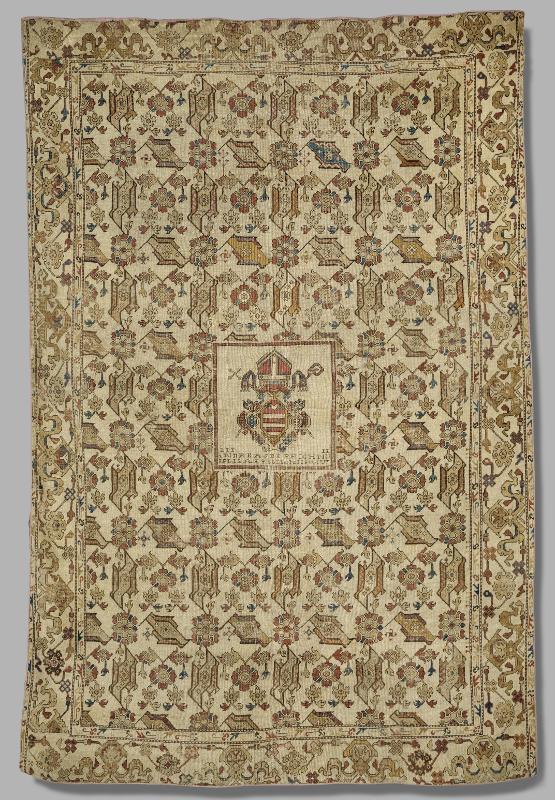
On an off-white ground, stylised birds and rosettes in pale red, blue, brownish beige, dark yellow, pink, greenish blue, dark brown are organised orthogonally and framed by a large edging with big cloudbandsattached by flowers and Slolmons knots, still in the same colours. The central medallion is ...
Visa hela
Warp of off-white wool, and two weft threads in the same colour. Symmetrical knots of ca. 1,190/dm2.
On an off-white ground, stylised birds and rosettes in pale red, blue, brownish beige, dark yellow, pink, greenish blue, dark brown are organised orthogonally and framed by a large edging with big cloudbandsattached by flowers and Slolmons knots, still in the same colours. The central medallion is square and shows a mitre and an inscription for the archbishop of Lemburg (Lviv) 1614-33, Johannes Andresa prochnicki, Poland.
Stäng
|
| Inventory number <itemDescription> |
|
| Acquisition <itemDescription> |
-
Gift from the estate of Axel and Nora Lundgren, registered the 29/9/1977. According to Lamm (1955) Lundgren got it from Streletskie who probably got it from a noble Swedish family who had it for about...
Visa hela
Gift from the estate of Axel and Nora Lundgren, registered the 29/9/1977. According to Lamm (1955) Lundgren got it from Streletskie who probably got it from a noble Swedish family who had it for about 200 years. Prior to that the emblem indicates it was owned by archbishop Próchnicki (1553-1633). Lamm (1955) suggests it was looted when Karl XII assaulted Lemberg in 1704.
Stäng
|
| Conservation / Executed <itemDescription> |
-
The rug is vacuum-cleaned, and surface dust was taken away with a soft bruch. It is rolled up on a paper stafetta, and wrapped into a cotton cover.
Flyttas till Etnografiska.
|
| Dimensions <itemDescription> |
|
| Exhibitions <itemDescription> |
|
| Cf Publications <itemDescription> |
-
Erdmann, K., Seven Hundred years of Oriental Carpets, p. 206-07, p. 263, ill. 3.
|
| Publications <itemDescription> |
-
Orientaliska Mattor,Nationalmuseum, Stockholm 1946, cat.nr. 39.
Islam - Konst och Kultur, Statens Historiska Museum, Sockholm 1985, cat. nr. 27.
Den Orientaliska Mattan i Sverige, Medelhavsmuseet, St...
Visa hela
Orientaliska Mattor,Nationalmuseum, Stockholm 1946, cat.nr. 39.
Islam - Konst och Kultur, Statens Historiska Museum, Sockholm 1985, cat. nr. 27.
Den Orientaliska Mattan i Sverige, Medelhavsmuseet, Stockholm 1998, cat. nr. 9.
Stäng
|
| Published text <itemDescription> |
-
"Anatolisk typ av så kalla fågelmatta från Ushak, troligen 1900-tal. Det vapen, som finns i mattans mitt har tillskrivits Andrzej Prochnicki, ärkebiskop av Lemberg i Polen i början av 1600-talet. Matt...
Visa hela
"Anatolisk typ av så kalla fågelmatta från Ushak, troligen 1900-tal. Det vapen, som finns i mattans mitt har tillskrivits Andrzej Prochnicki, ärkebiskop av Lemberg i Polen i början av 1600-talet. Mattan visar emellertid flera ovanliga drag, speciellt i vävsättet, som skulle kunna tyda på att den är en av de många kopior av de anatolska fågelmattorna och liknande mattor med vit bottenfärg, som tillverkades i Europa på 1930-talet". (Richert 1985, s. 200)
"Mattans ålder har...ifrågasatts av forskare, som hävdar att den tillhör en grupp förfalskningar utförda i början av 1900-talet". (Ådahl 1998:18)
Stäng
|
| Published text <itemDescription> |
-
The rectangular rug belongs to the group of so-called 'bird' rugs. These rugs are distinguished by their cream white ground and by their use of mainly warm, earthy hues – yellow, red and brown – contr...
Visa hela
The rectangular rug belongs to the group of so-called 'bird' rugs. These rugs are distinguished by their cream white ground and by their use of mainly warm, earthy hues – yellow, red and brown – contrasted with small areas of blue and greenish-blue. The design of the rug is divided into a central field and a border. The significant motif of the design, which gives it its name, is a shape resembling a stylised double-headed bird, always with four birds arranged around a large blossom forming the repetitive design of the central field. The areas between them are filled with a standardised motif composed of a central rosette and four blossoms on stems. Additional small rosettes and whirling motifs are set between the large blossoms and the birds of the horizontal lines. The framed border has cloud-bands, which are connected to each other by arabesques.
This rug, however, shows a peculiarity which distinguishes it from the usual style of bird rugs. In the middle of the rug is a nearly square field showing a coat of arms and a mitre. The inscription underneath names the person for whom the rug was probably made, Archbishop Johannes Andreas Próchnicki. Próchnicki was Latin archbishop of Lemberg (Lviv) from 1614 until his death in 1633. It is assumed that the Armenians of Lemberg who had close connections with Istanbul helped Próchnicki to obtain this rug. That it was an order is evident from some illegible letters within the inscription. It is also interesting to know that some of the preserved Persian carpets commissioned by an Armenian of Lemberg on behalf of the Polish King Sigismund III in 1601/02 in Kashan also show a middle square including the king's coat of arms.
In 1704 the Swedish King Charles XII (1682–1718) conquered Lemberg (Lviv). We can assume that the rug was part of the booty of this war. Afterwards, the rug is supposed to have been the property of a noble Swedish family for about 200 years before it was sold to the collectors Axel and Nora Lundgren in 1937. Original Owner:
Johannes Andreas Próchnicki (d. 1633), Latin archbishop of Lemberg (Poland) How date and origin were established:
The inscription in the central field of the rug refers to Johannes Andreas Próchnicki who was archbishop of Lemberg from 24 November 1614 until his death in 1633. How Object was obtained:
Gift from the estate of Axel and Nora Lundgren, registered in 1977. How provenance was established:
So-called bird rugs with cream-white grounds are usually assigned to Ushak in west Turkey. Furthermore, after the fall of Constantinople to the Ottomans in 856 / 1453 there was a brisk trade with the Armenians of Lemberg. The predecessor of Johannes Andreas Próchnicki had bought 20 rugs in Constantinople to embellish the cathedral of Lemberg. Source: [https://islamicart.museumwnf.org/database_item.php?id=object;ISL;se;Mus01;18;en&cp]
Stäng
|
| Source / http <itemDescription> |
|
| Exhibition / Previously <itemDescription> |
|
| Loan out / Current <itemDescription> |
|
| Name / Loantaker <itemDescription> |
|
| Description, Swedish <itemDescription> |
|
| Geographic name, alternative <itemDescription> |
|
| Referens, publicerad i <itemDescription> |
|
| Referens, publicerad i <itemDescription> |
-
Lamm, C. J. (1955) Ein Türkischer Wappenteppich in Schwedischem Besitz, Kunst des Orients II, pp.59–68.
|
| Referens, publicerad i <itemDescription> |
-
Richert, Annika (red.) (1985). Islam: konst och kultur = Islam : art and culture : en utställning i samproduktion mellan Statens historiska museum, Kungl. Myntkabinettet och Medelhavsmuseet. Stockholm...
Visa hela
Richert, Annika (red.) (1985). Islam: konst och kultur = Islam : art and culture : en utställning i samproduktion mellan Statens historiska museum, Kungl. Myntkabinettet och Medelhavsmuseet. Stockholm: Statens historiska mus.
Stäng
|
| Referens, publicerad i <itemDescription> |
|
| Referens, publicerad i <itemDescription> |
|
| Referens, källa <itemDescription> |
|
| Händelse <context> |
-
Förvärvad av Lundgren, Axel, Streletskie, Henri Jacques.
-
Brukad i Lviv, Ukraina, Europa.
-
Ursprung i Turkiet, Asien.
-
Ägd av Nationalmuseum, Stockholm.
-
Tillverkad 1575 - 1625 .
-
Insamlad 1704 av Karl XII [?].
|
| Material, engelska<itemMaterial> |
- Wool
|
| Nyckelord <itemKeyWord> |
-
Próchnicki, Johannes Andreas
-
Stora nordiska kriget (1700-1721) [?]
-
Stormningen av Lemberg (1704) [?]
-
2008.03.0030
-
Carl XII
|
| Object<itemName> |
- rug (uschak)
|
| Ämne <subject> |
|
| Inventory number <itemNumber> |
|
| Previous ID <itemNumber> |
|
| Rättigheter för metadata <itemLicense> |

|
| Källa <presOrganization> |
Statens museer för världskultur - Medelhavsmuseet |
|
Källa <url>
|
|


 ARTIKLAR I WIKIPEDIA
 ARTIKLAR I WIKIDATA
 BILDER I WIKIMEDIA COMMONS


