| Typ <itemType> |
Objekt/föremål |
| Plats <presPlaceLabel> |
Afrika, Zambia |
| Beskrivning <itemDescription> |
|
| Publicerad text, engelska <itemDescription> |
-
"In close combat, when high and dense papyrus makes it impossible to use a bow and spear, the batwa fight with knives, which they also use to catch and skin the felled quarry. That the knife plays a f...
Visa hela
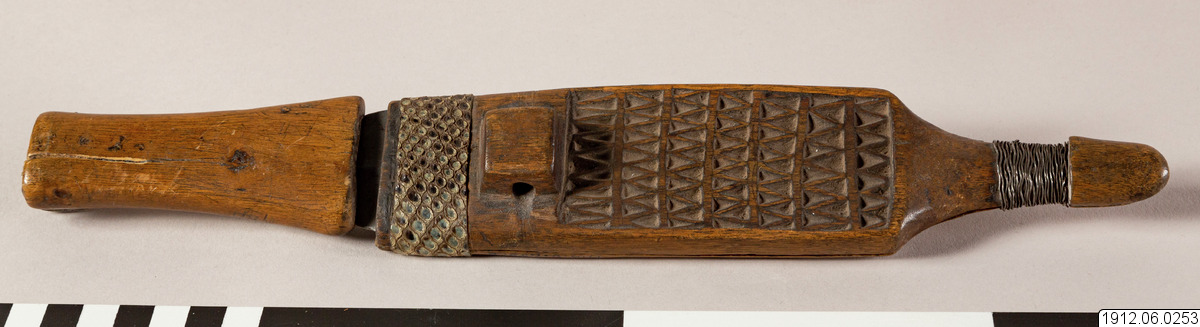
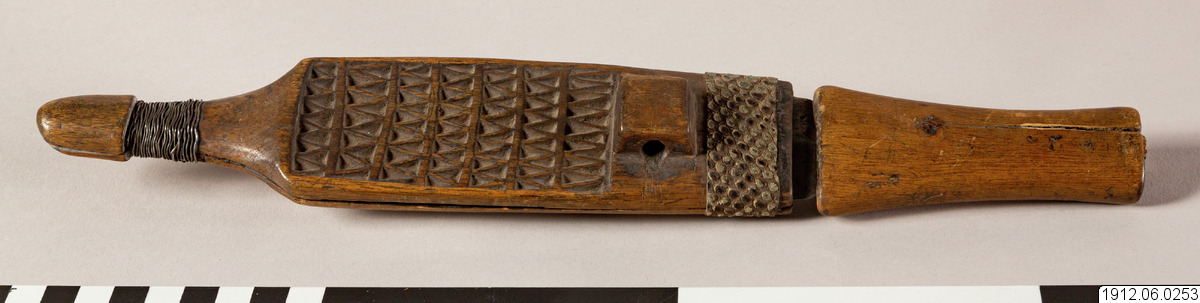
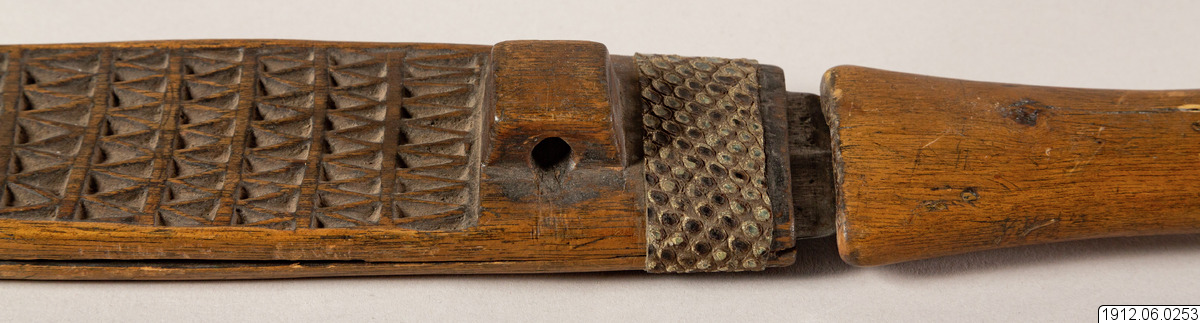
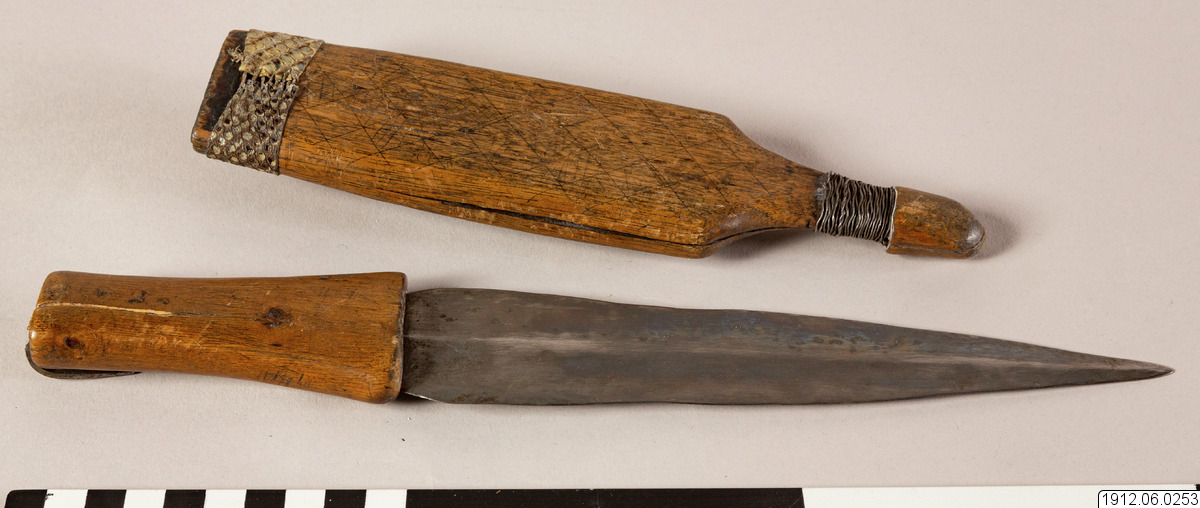
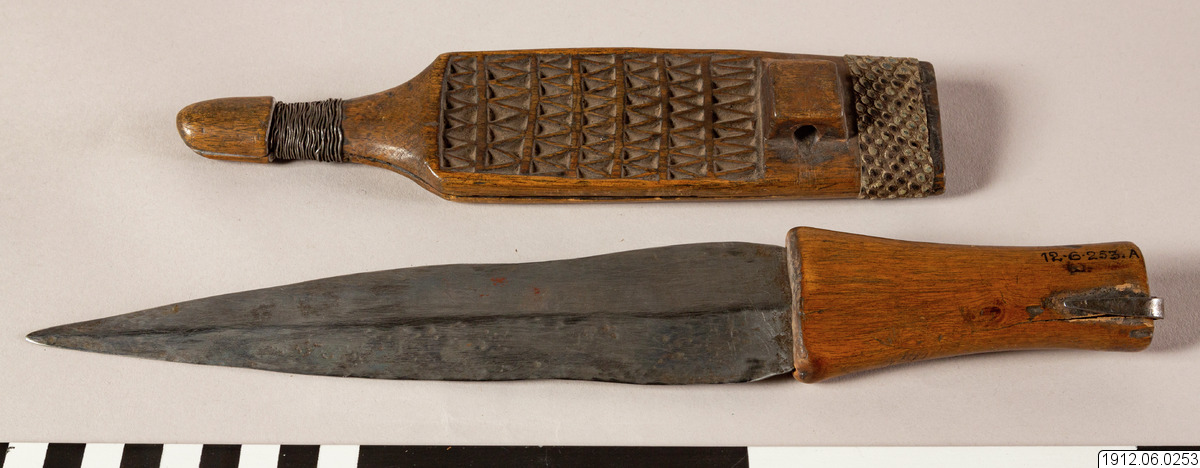
"In close combat, when high and dense papyrus makes it impossible to use a bow and spear, the batwa fight with knives, which they also use to catch and skin the felled quarry. That the knife plays a fairly large role in the battles of the Batwa people, I understood from the opinions of both babisa and waunga men. When, at the beginning of our stay at the swamp, I once suggested that some men of these tribes should accompany me on an excursion into the swamp, they replied that then the swamps would cut their throats with their knives, and when I once asked a batwa, to which he used his large dagger, so he stroked the front of his neck with his hand while making a hissing sound. The gesture could not be misunderstood! The knife blades are always double-edged and usually of a lanceolate shape (Figs. 92-94), more rarely they have the shape seen in Fig. 90. The blade is provided with a pair of pliers, which is inserted into a wooden shaft. The knife blades are generally made of babisa's skids, only the coarser and inferior specimens have been forged by swamps (fig. 94). The knives are stored in wooden sheaths. These are made in two halves, which are held together at the top and bottom with windings of metal wire, snakeskin or bast. Near the upper edge of the sheath there is always a pierced projecting button intended for the strap, in which the knives are worn around the neck or fastened to the outer side of the left upper arm. The sheaths are sometimes provided with ornaments (Figs. 91 and 95). The original of Fig. 90 is 30.5 cm. long, of which 21 cm. get on the blade. The pliers, which have been inserted through a hole in the shaft, have been longer than this, so that the projecting part is bent downwards. The sheath belonging to the knife (fig. 91) is 22.4 cm. long. It is wound at the top with lizard skin, at the bottom with iron wire. On one side, rows of angles are deeply cut. The opposite side is provided with carelessly carved squares." (pp. 199-200, von Rosen, 1916, translated from Swedish).
Stäng
|
| Beskrivning / engelska <itemDescription> |
-
According to the general catalog: Hunting knife with wooden sheath. One side of the sheat with sculpted angular ornaments, the other with engraved squares. Winding of lizard skin. (Varanus). The sheat...
Visa hela
According to the general catalog: Hunting knife with wooden sheath. One side of the sheat with sculpted angular ornaments, the other with engraved squares. Winding of lizard skin. (Varanus). The sheath at the bottom is wound with metal wire.
Stäng
|
| Utställning / tidigare <itemDescription> |
|
| Referens, publicerad i <itemDescription> |
|
| Geografiskt namn / annat <itemDescription> |
|
| Geografiskt namn / annat <itemDescription> |
|
| Land / engelska <itemDescription> |
|
| Geografiskt namn / annat <itemDescription> |
|
| Geografiskt namn / annat <itemDescription> |
|
| Händelse / var närvarande vid <itemDescription> |
|
| Händelse / var närvarande vid <itemDescription> |
|
| Händelse / var närvarande vid <itemDescription> |
|
| Händelse <context> |
-
Insamlad av Rosen, Eric von.
-
Brukad av Twa.
-
Ursprung i Zambia, Afrika.
-
Förvärvad 1912 .
-
Utställd 1913-02-04 - i Konstakademien, Stockholm av Rhodesia-Kongo-Expeditionens utställning.
|
| Material, engelska<itemMaterial> |
- wood
|
| Materialkategori<itemMaterial> |
- läder-skinn-päls
- trä
|
| Material<itemMaterial> |
- trä
- ödleskinn
|
| Nyckelord <itemKeyWord> |
-
1912.06.0253
-
Batwa
-
Eric von Rosen
-
Jakt och fångst till lands (224)
-
Kap till Kairo
-
Kap-Kairo-expeditionen
-
Samlande, Jakt och Fiske (220)
-
Twa
-
WHMZ
-
forskarbesök
-
jaktkniv
-
von Rosen, Eric
|
| Sakord, engelska<itemName> |
- hunting knife
- hunting-knife
|
| Sakord<itemName> |
- kniv
|
| Ämne <subject> |
|
| Inventarienummer <itemNumber> |
|
| Rättigheter för metadata <itemLicense> |

|
| Källa <presOrganization> |
Statens museer för världskultur - Etnografiska museet |
|
Källa <url>
|
|

 ARTIKLAR I WIKIPEDIA
 ARTIKLAR I WIKIDATA
 BILDER I WIKIMEDIA COMMONS


