| Typ <itemType> |
Objekt/föremål |
| Plats <presPlaceLabel> |
Oceanien, Franska Polynesien, Marquesasöarna, Nuku Hiva |
| Beskrivning <itemDescription> |
|
| Anmärkning <itemDescription> |
-
Provenance: This tapa was brought to Sweden by the Vanadis expedition (1883-1885). On board, was the Swedish archaeologist and ethnographer Hjalmar Stolpe, who collected approximately 7500 specimens...
Visa hela
Provenance: This tapa was brought to Sweden by the Vanadis expedition (1883-1885). On board, was the Swedish archaeologist and ethnographer Hjalmar Stolpe, who collected approximately 7500 specimens and objects for the intended ethnographical museum in Sweden. In May 1884, the Vanadis reached Nuku Hiva and acquired a number of items in Taioha‘e, the harbour on the south coast of the island, principal anchorage point for ships, which would later become the administrative capital of the Marquesas. In his notebook, Stolpe records the donation of this tapa by Prince Stanislaus (or Stanislas), son of King Temoana, in Taioha‘e, Hakaui Valley, together with a paddle. (Héloise Dazard 2025).
Stäng
|
| Anmärkning <itemDescription> |
-
Like elsewhere in Polynesia, the making of barkcloth – known as tapa - in the Marquesas Islands was traditionally carried out by women. Made from the bast (inner bark) of certain trees, it was most of...
Visa hela
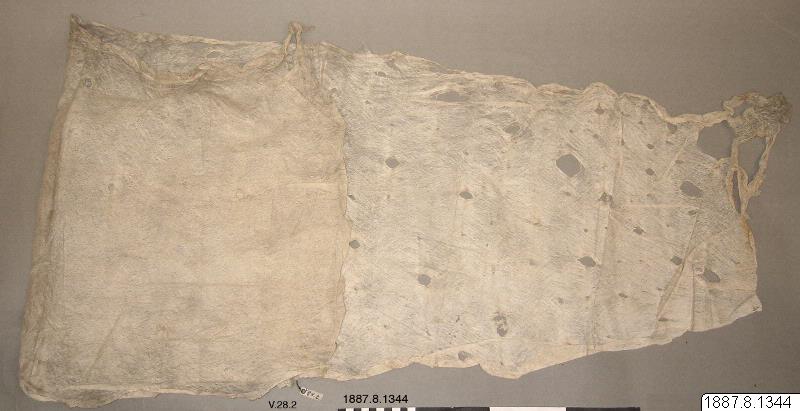
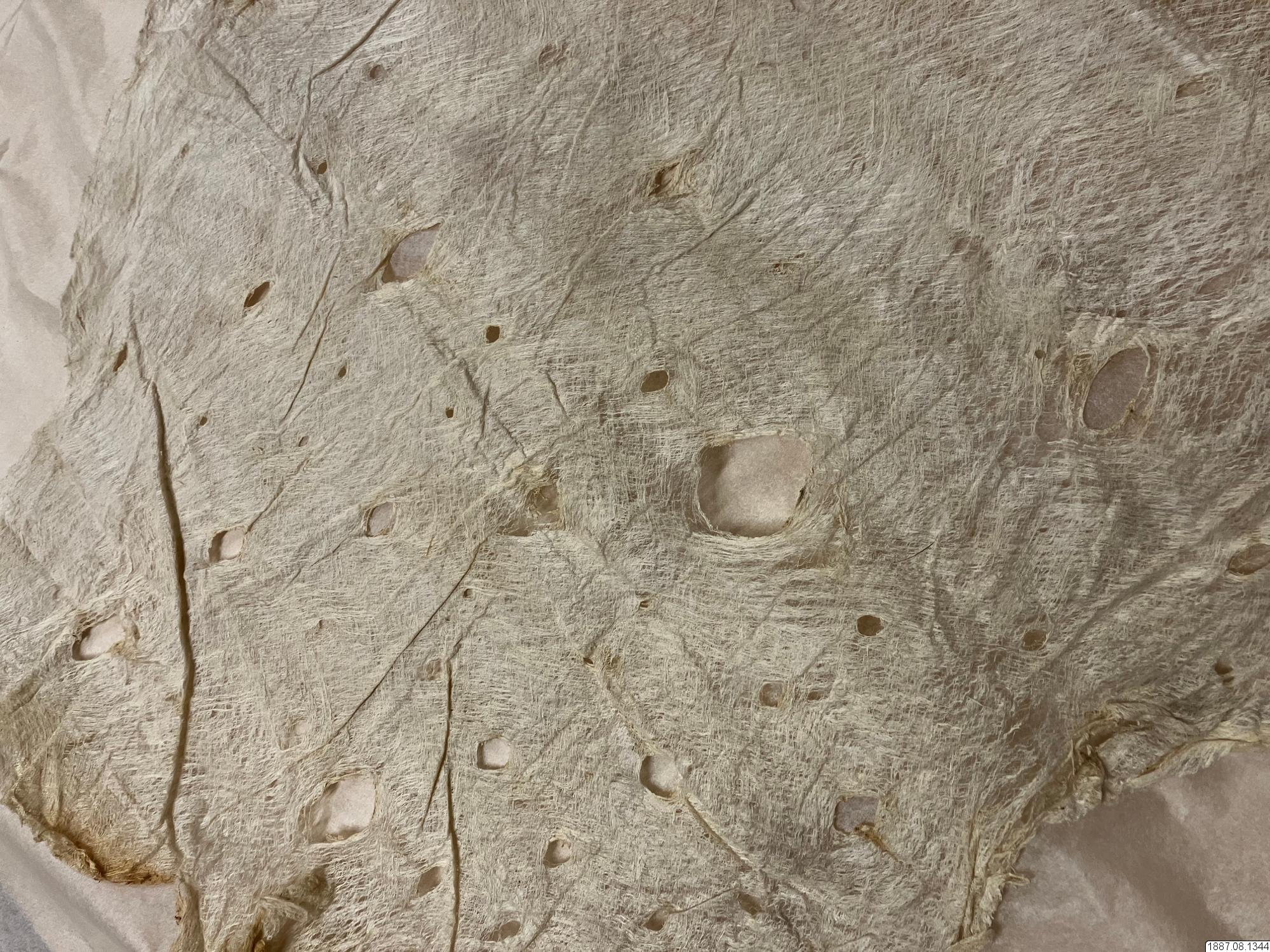
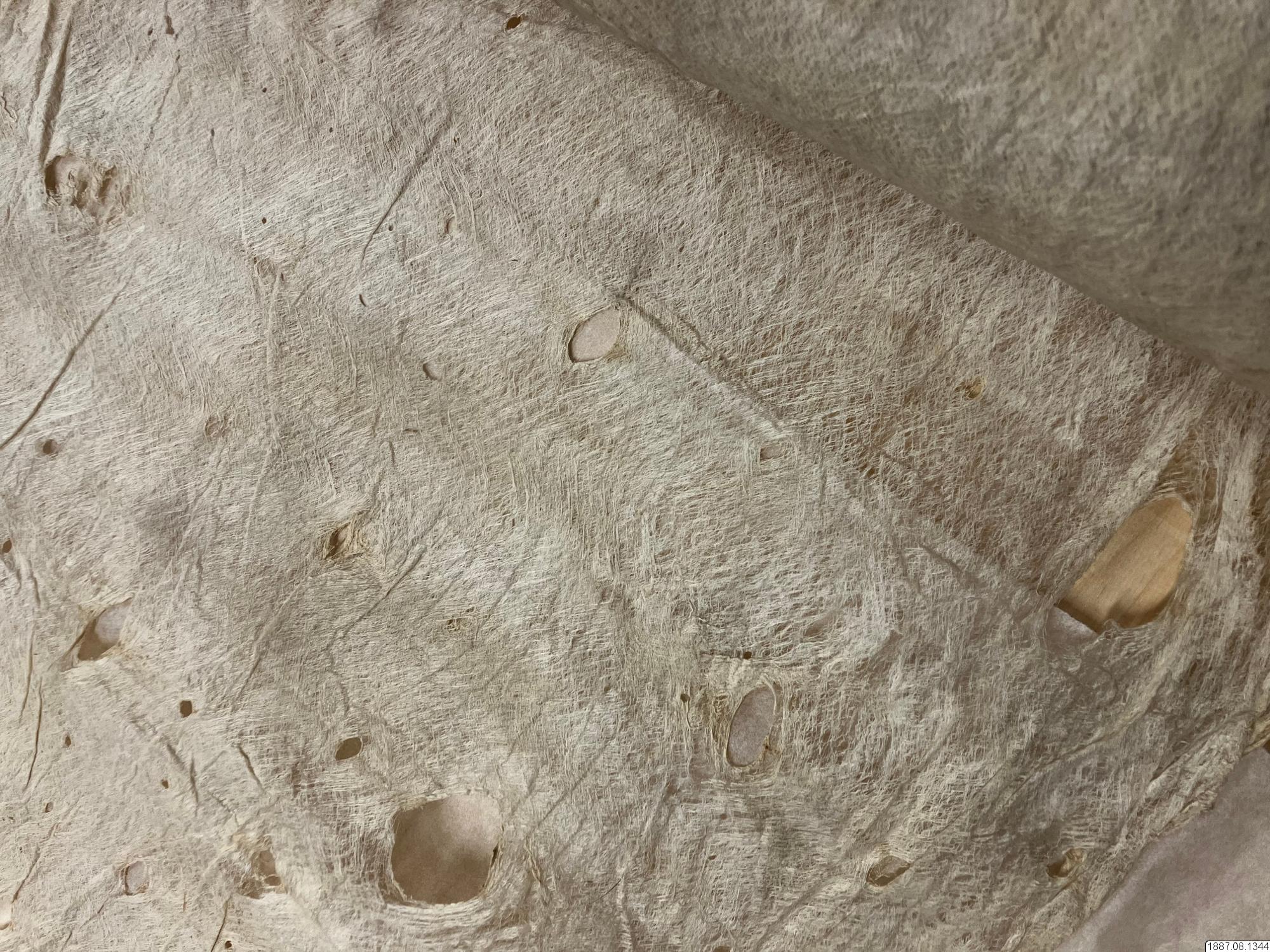
Like elsewhere in Polynesia, the making of barkcloth – known as tapa - in the Marquesas Islands was traditionally carried out by women. Made from the bast (inner bark) of certain trees, it was most often left undecorated. To Western visitors, such plain cloths appeared to hold little aesthetic or commercial interest, yet within Marquesan society they were deeply valued and widely used in both everyday and ceremonial contexts. Once the bark was stripped away, the bast was separated from the outer layer. It was then beaten using tools made from the hard wood of the toa tree (Casuarina equisetifolia). Following the beating process, the material was treated with fresh water and subjected to a period of fermentation before being laid out in the sun to dry. Larger sheets were produced by felting individual pieces together through further beating. In the Marquesas islands, paper mulberry (Broussonetia papyrifera) known locally as ute, was regarded as producing the “best” cloth, valued for its softness, smoothness, and whiteness. It was, however, in relatively short supply, likely due to the limited availability of suitable land for its cultivation. As a result, breadfruit (Artocarpus altilis) appears to have provided much of the cloth worn by ordinary Marquesans. Historical sources describe breadfruit tapa as coarser in texture and more beige or grey in colour. The present example, with its whiteness and lace-like texture, appears to have been made from paper mulberry bast. Because the beating process destroys the cellular structure of the fibres, scientific analysis is of limited value in identifying the tree species used. Fine white robes were reserved for special occasions and ceremonies. Women sometimes wore extremely thin tapa in their hair, while priests used plain tapa as headdresses or turbans. During feasts and ritual exchanges, plain tapa was a prestigious gift, and before a battle, it could be offered to the gods in order to seek protection or favour. In death, tapa also accompanied the body, serving as a shroud for the deceased. These undecorated white cloths, often overlooked by outsiders, thus occupied a central place in Marquesan culture. Their uses reveal tapa not merely as a utilitarian fabric, but as a material embedded in social relations, ritual practice, and the cycles of life and death. (Héloise Dazard 2025).
Stäng
|
| Källor <itemDescription> |
|
| Källor <itemDescription> |
-
Mills, Andy. “The Procurement, Cultural Value and Fabric Characteristics of Polynesian Tapa Species” in Lennard, Frances & Mills, Andy (ed.), Material Approaches to Polynesian Barkcloth, Leiden, Sides...
Visa hela
Mills, Andy. “The Procurement, Cultural Value and Fabric Characteristics of Polynesian Tapa Species” in Lennard, Frances & Mills, Andy (ed.), Material Approaches to Polynesian Barkcloth, Leiden, Sidestone press, 2020, p.29-24
Stäng
|
| Källor <itemDescription> |
|
| Källor <itemDescription> |
-
Stolpe, Hjalmar. "Dagbok, Vanadis, vol.03, Nuku Hiva, Fakarava, Tahiti", 1884, Etnografiska museet: https://archive.org/details/o-01-10-03-images/page/n19/mode/2up
|
| Geografiskt namn / annat <itemDescription> |
|
| Geografiskt namn / annat <itemDescription> |
|
| Geografiskt namn / annat <itemDescription> |
|
| Geografiskt namn / annat <itemDescription> |
|
| Geografiskt namn / annat <itemDescription> |
|
| Geografiskt namn / annat <itemDescription> |
|
| Land / engelska <itemDescription> |
|
| Geografiskt namn / annat <itemDescription> |
|
| Geografiskt namn / annat <itemDescription> |
|
| Händelse / var närvarande vid <itemDescription> |
|
| Händelse, del av / var närvarande vid <itemDescription> |
|
| Händelse <context> |
-
Insamlad av Stanislaus, Prins.
-
Ursprung i Marquesasöarna, Franska Polynesien, Oceanien.
-
Förvärvad 1887 av Stolpe, Hjalmar.
|
| Material, engelska<itemMaterial> |
- plant fiber
|
| Materialkategori<itemMaterial> |
- textil
- växtmaterial
|
| Material<itemMaterial> |
- växtfiber
- bark
|
| Teknik <itemTechnique> |
|
| Nyckelord <itemKeyWord> |
-
1887.08.1344
-
Stanislaus
-
V.28.2
-
Vanadisexpeditionen
-
tyg
|
| Mått <itemMeasurement> |
-
Höjd: 150 cm.
-
Bredd: 55 cm.
|
| Sakord, engelska<itemName> |
- barkcloth
|
| Sakord<itemName> |
- tapa
- barktyg
|
| Ämne <subject> |
|
| Inventarienummer <itemNumber> |
|
| Tidigare identitet <itemNumber> |
|
| Rättigheter för metadata <itemLicense> |

|
| Källa <presOrganization> |
Statens museer för världskultur - Etnografiska museet |
|
Källa <url>
|
|

 ARTIKLAR I WIKIPEDIA
 ARTIKLAR I WIKIDATA
 BILDER I WIKIMEDIA COMMONS


