| Typ <itemType> |
Objekt/föremål |
| Datering <presTimeLabel> |
Coptic Period (probably 7th-8th century) |
| Plats <presPlaceLabel> |
Afrika, Egypten |
| Description <itemDescription> |
-
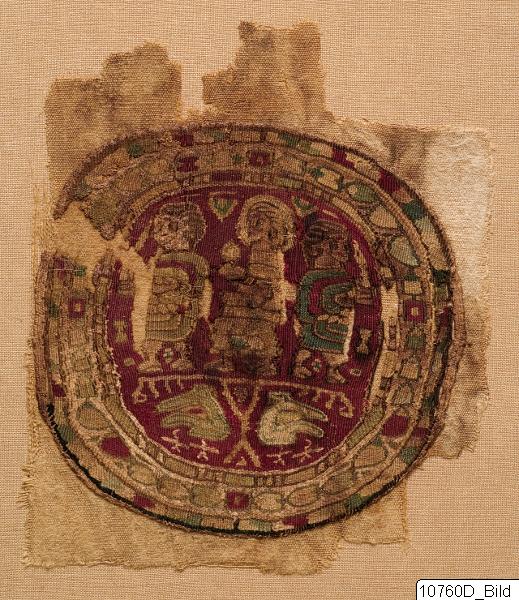
Fragment of decorative roundel (orbiculus), colours red, green, yellow and black. Inside the roundel there is three human figures visible (possibly depicting Joseph with brothers), the centre figure is dressed in a long dress (probably a tunic) with yellow hair and a halo. The human figure on the right side, facing away from the central figure is wearing a shorter dress (or tunic) and has black ha...
Visa hela
Fragment of decorative roundel (orbiculus), colours red, green, yellow and black. Inside the roundel there is three human figures visible (possibly depicting Joseph with brothers), the centre figure is dressed in a long dress (probably a tunic) with yellow hair and a halo. The human figure on the right side, facing away from the central figure is wearing a shorter dress (or tunic) and has black hair, the human figure on the left side is also facing away from the central figure and is almost identical to the right-side figure. The figures stand on a horizontal line, which also form the branches of a tree (possibly the Tree of life). At each side of the trunk there is a bird with its head turned away and its claws stretched out from its formless appearance, the components create a symmetrical unit. The border is divided into three sections, the inner band is made up of different coloured section, the middle band is a repetitive flower petal pattern, the outer band has a pattern with ”gems”.
Stäng
|
| Inventory number <itemDescription> |
|
| Acquisition <itemDescription> |
|
| Comments <itemDescription> |
|
| Condition <itemDescription> |
|
| Parallels <itemDescription> |
-
MM 18431, MM 18433, MM 18434, MM 18435, MM 18437
|
| Period, Swedish <itemDescription> |
|
| Publications <itemDescription> |
|
| Country / Findspot <itemDescription> |
|
| Loan out / Current <itemDescription> |
|
| Name / Loantaker <itemDescription> |
|
| Description, Swedish <itemDescription> |
-
Fragment av dekorativ medaljong (orbiculus), röd, grön, gul och svart färg. Inuti medaljongen finns tre människofigurer synliga (möjligen att de föreställer Josef med bröder), mittfiguren är klädd i e...
Visa hela
Fragment av dekorativ medaljong (orbiculus), röd, grön, gul och svart färg. Inuti medaljongen finns tre människofigurer synliga (möjligen att de föreställer Josef med bröder), mittfiguren är klädd i en lång klänning (troligen en tunika) med gult hår och en gloria. Människofiguren på höger sida är bortvänd från den centrala figuren, han är klädd i en kortare klänning (eller tunika) med svart hår, människofiguren på vänster sida är också bortvänd från den centrala figuren och är nästan identisk till människofiguren på höger sida. Figurerna står på en horisontell linje, som också bildar grenarna på ett träd (möjligen Livets träd). På vardera sida av stammen finns en fågel med huvudet bortvänt och klorna utsträckta från sitt formlösa utseende, komponenterna skapar en symmetrisk enhet. Det finns en trebandsbård, det inre bandet består av olika färgade sektioner, mittbandet är ett repetitivt blombladsmönster, det yttre bandet har ett mönster med ”ädelstenar”.
Stäng
|
| Acquisition, Swedish <itemDescription> |
|
| Egyptenutställningen 2014, English / Label <itemDescription> |
-
It took a long time before the Egyptians abandoned the thought of preserving the body even after death. In certain places they continued to mummify bodies well into the eighth century.
Caring for the ...
Visa hela
It took a long time before the Egyptians abandoned the thought of preserving the body even after death. In certain places they continued to mummify bodies well into the eighth century.
Caring for the deceased continued even afterwards, which can be seen in the many surviving shrouds that have been found in tombs. Shrouds were often reused festive dress. They were colourfully decorated in comparison with older white linen dress.
The decoration was woven in wool or linen
and sewn on as roundels or bands. When the tunic was worn out, the decorations could be cut out, saved and sewn unto a new garment.
The motifs were many. People and animals were amongst the most common, often taken from pagan mythology. They inspired medieval artists in both the Middle East and Europe.
Stäng
|
| Egyptenutställningen 2014, Swedish / Label <itemDescription> |
-
Det dröjde innan egyptierna släppte tanken på att bevara kroppen även efter döden. På vissa platser fortsatte man att mumifiera sina döda ända in på 700-talet.
Omsorgen om de avlidna fortlevde även dä...
Visa hela
Det dröjde innan egyptierna släppte tanken på att bevara kroppen även efter döden. På vissa platser fortsatte man att mumifiera sina döda ända in på 700-talet.
Omsorgen om de avlidna fortlevde även därefter, vilket syns i de många bevarade svepningar som hittats i gravar.
Svepningarna var ofta återanvända festkläder. De var färggrant dekorerade jämfört med äldre tiders vita linnedräkter. Dekoren vävdes
i ullgarn eller linne och syddes på som rundlar eller band. När tunikan blev sliten kunde
applikationerna klippas ut, sparas och sys på ett nytt plagg.
Motiven var många. Bland de vanligaste var människor och djur, ofta hämtade ur hednisk mytologi. De inspirerade medeltida konstnärer i både Mellanöstern och Europa.
Stäng
|
| Händelse <context> |
-
Brukad Coptic Period (probably 7th-8th century).
-
Funnen i Egypten, Afrika.
|
| Material, engelska<itemMaterial> |
- Textile
- Wool
|
| Material<itemMaterial> |
- Textil
- Ylle
|
| Nyckelord <itemKeyWord> |
-
Coptic Period (probably 7th-8th century)
-
coptic
-
koptisk
-
2007.11.0019
|
| Mått <itemMeasurement> |
-
Length / Längd: 26,5 cm.
-
Width / Bredd: 22,5 cm.
|
| Object, Swedish<itemName> |
- textilfragment
- bonad
|
| Object<itemName> |
- textile fragment
- tapestry
|
| Ämne <subject> |
|
| Inventory number <itemNumber> |
|
| Acquisition number <itemNumber> |
|
| Previous ID <itemNumber> |
|
| Rättigheter för metadata <itemLicense> |

|
| Källa <presOrganization> |
Statens museer för världskultur - Medelhavsmuseet |
|
Källa <url>
|
|


 ARTIKLAR I WIKIPEDIA
 ARTIKLAR I WIKIDATA
 BILDER I WIKIMEDIA COMMONS