| Typ <itemType> |
Objekt/föremål |
| Datering <presTimeLabel> |
Roman |
| Description <itemDescription> |
-
An unguentarium (pl. unguentaria) is a small container, typically made of clay or glass, for oil and perfumes. They are mostly associated with Hellenistic and Roman contexts, especially as grave goods.
|
| Description <itemDescription> |
-
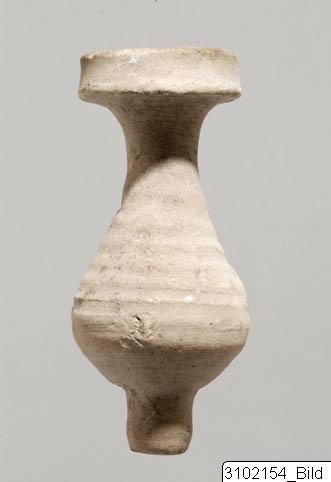
Bulbous, piriform body. Tall, cylindrical base. Fairly tall, concave neck. Sharply articulated, collar-mouth. Shallow, horizontal grooves down body. Semi-fine, pale grayish-brown fabric with fine mica...
Visa hela
Bulbous, piriform body. Tall, cylindrical base. Fairly tall, concave neck. Sharply articulated, collar-mouth. Shallow, horizontal grooves down body. Semi-fine, pale grayish-brown fabric with fine mica.
Stäng
|
| Inventory number <itemDescription> |
|
| Acquisition <itemDescription> |
-
Bequest of Mrs. Carolina Benedicks-Bruce, Visby, 1934, to the National Museum, Stockholm.
|
| Comments <itemDescription> |
-
An unguentarium (pl. unguentaria) is a small container, typically made of clay or glass, for oil and perfumes. They are mostly associated with Hellenistic and Roman contexts, especially as grave goods...
Visa hela
An unguentarium (pl. unguentaria) is a small container, typically made of clay or glass, for oil and perfumes. They are mostly associated with Hellenistic and Roman contexts, especially as grave goods. The so-called fusiform shape (from the Latin fusus, meaning “spindle”) is characteristic of Hellenistic unguentaria and is thought to have developed functionally from the lekythos. On the other hand, the so-called piriform shape (from the Latin pirus, meaning “pear”) is characteristic of the Roman era, especially the early Principate.
Stäng
|
| Comments <itemDescription> |
-
Date confirmed by J. Hayes, who examined the vessel in november 1993. The object was identified by mr. Hayes as a stopper. The vessel was probably not originally manufactured as a stopper though, but ...
Visa hela
Date confirmed by J. Hayes, who examined the vessel in november 1993. The object was identified by mr. Hayes as a stopper. The vessel was probably not originally manufactured as a stopper though, but has, according to its shape, more likely been re-used and/or re-shaped for this purpose.
Stäng
|
| Condition <itemDescription> |
|
| Dimensions <itemDescription> |
|
| Händelse <context> |
-
Förvärvad av Benedicks-Bruce, Carolina.
-
Brukad Roman.
-
Ägd av Nationalmuseum, Stockholm.
|
| Material, engelska<itemMaterial> |
- Earthenware
- Pottery
- Clay
|
| Material<itemMaterial> |
- Keramik
|
| Nyckelord <itemKeyWord> |
-
Roman
-
balsamarium
-
ceramics
-
lacrimarium
-
pottery
-
vessel
|
| Mått <itemMeasurement> |
-
Height / Höjd: 11 cm.
-
Diameter: 4,5 cm.
|
| Object, Swedish<itemName> |
- flaska
- kärl
|
| Object<itemName> |
- unguentarium
- stopper
|
| Ämne <subject> |
|
| Inventory number <itemNumber> |
|
| Rättigheter för metadata <itemLicense> |

|
| Källa <presOrganization> |
Statens museer för världskultur - Medelhavsmuseet |
|
Källa <url>
|
|


 ARTIKLAR I WIKIPEDIA
 ARTIKLAR I WIKIDATA
 BILDER I WIKIMEDIA COMMONS